

Managing a fleet in Kenya is no longer just about knowing where vehicles are. Rising fuel costs, road safety concerns, vehicle downtime, cargo security, and increasingly complex logistics operations are forcing businesses to rethink how they manage their vehicles and drivers.
The right fleet management companies in Kenya can help businesses reduce operating costs, improve driver safety, protect assets, and make better decisions using real-time data and AI-powered telematics. But with different providers offering everything from GPS tracking to vehicle leasing and driver training, choosing the right solution requires understanding what each type of provider actually delivers.
This guide explores Kenya’s fleet management landscape, the biggest challenges facing fleet operators, the technologies to look for, and the leading providers to consider.
The Growing Need for Fleet Management in Kenya
Kenya plays an important role in East Africa’s logistics and transportation network. Nairobi serves as a major commercial and distribution hub, while the Port of Mombasa connects Kenya and neighboring landlocked countries to international trade routes.
This creates a broad ecosystem of commercial vehicles, including logistics trucks, delivery vans, passenger vehicles, construction equipment, agricultural vehicles, service fleets, and government vehicles.
As fleet operations become larger and more distributed, manually managing vehicles through spreadsheets, phone calls, and basic GPS trackers is increasingly inefficient. Fleet operators need visibility into not only where vehicles are, but also how they are being driven, how much fuel they consume, when they need maintenance, and whether they are being used efficiently.
The Current Landscape of Logistics and Mobility in East Africa
Kenya’s position as a regional transport and logistics hub creates demand for reliable fleet operations. Long-distance freight routes, urban delivery networks, construction projects, agricultural transportation, and passenger transport all require vehicles to operate efficiently across very different environments.
A fleet may operate in Nairobi’s congested urban roads one day and on long-distance highways or challenging rural terrain the next. This makes vehicle visibility, route monitoring, fuel management, and driver safety especially important.
The growth of e-commerce and last-mile delivery has also increased the need for businesses to know where vehicles are and when deliveries are expected to arrive.
Why Kenyan Businesses Need Dedicated Fleet Management Solutions
Fleet management software can bring vehicle, driver, fuel, maintenance, and operational data into one platform.
Instead of relying on disconnected systems, fleet managers can use a centralized dashboard to monitor:
- Real-time vehicle locations
- Driver behavior and safety
- Fuel consumption
- Vehicle utilization
- Maintenance schedules
- Route deviations
- Geofence activity
- Trip history
- Fleet performance
For businesses operating dozens or hundreds of vehicles, this visibility can translate directly into lower operating costs, improved safety, and better customer service.
Key Challenges Facing Fleet Operators in Kenya
Although every fleet has different requirements, several challenges consistently affect commercial fleet operations in Kenya.
High Fuel Costs and Mitigating Fuel Theft / Siphoning
Fuel is one of the most significant recurring costs for many commercial fleets. Inefficient driving, excessive idling, unauthorized fuel use, and fuel siphoning can quickly increase operating expenses.
Traditional fuel records may show how much fuel was purchased, but they don’t necessarily explain how efficiently that fuel was consumed.
Modern fleet management solutions combine GPS, fuel sensors, vehicle data, and analytics to identify unusual fuel activity. Fleet managers can compare fuel consumption with distance traveled, vehicle type, route, and driver behavior.
This makes it easier to detect:
- Unexpected fuel consumption
- Fuel theft or siphoning
- Excessive idling
- Unauthorized fuel events
- Inefficient driving patterns
- Unusual fuel usage on specific routes
Driver Safety, Road Incidents, and Compliance Risks
Driver behavior directly affects safety, fuel consumption, maintenance costs, and accident risk.
Speeding, harsh braking, aggressive acceleration, fatigue, and distracted driving can increase the likelihood of incidents while also putting additional stress on vehicles.
Fleet management technology allows companies to monitor driver behavior and identify recurring risk patterns. Video telematics and AI-powered cameras can add another layer of visibility by helping fleet managers understand what happens inside and around a vehicle.
Instead of simply reacting to accidents, fleet managers can use driver performance data to coach drivers before unsafe behavior results in an incident.
Vehicle Wear and Tear Across Diverse Terrain and Urban Congestion
Vehicles operating across Kenya can experience very different operating conditions. Heavy traffic, long-distance routes, poor road conditions, heavy loads, and frequent stop-and-go driving can all contribute to vehicle wear.
Unplanned breakdowns can create more than repair costs. A vehicle sitting in a workshop can mean missed deliveries, delayed projects, dissatisfied customers, and lost revenue.
Fleet managers therefore need to move from reactive maintenance toward preventive and predictive maintenance.
Core Features to Look For in a Kenyan Fleet Management Partner
Not every GPS tracking company provides comprehensive fleet management. When comparing fleet management companies in Kenya, businesses should look beyond basic location tracking.
Real-Time GPS Tracking and Geofencing
Real-time GPS tracking provides fleet managers with visibility into vehicle locations, routes, stops, and movement.
Geofencing takes this further by creating virtual boundaries around locations such as:
- Depots
- Warehouses
- Customer sites
- Construction sites
- Restricted areas
- Delivery zones
Automated alerts can notify fleet managers when vehicles enter or leave predefined areas or deviate from an approved route.
AI-Powered Fuel Monitoring and Analytics
Fuel management becomes significantly more useful when fuel data is connected with vehicle and driver information.
AI-powered analytics can help identify anomalies and provide insights into:
- Fuel consumption
- Fuel efficiency
- Idling
- Fuel theft
- Unusual fuel events
- Driver performance
- Vehicle utilization
The objective is not simply to monitor fuel levels but to understand why fuel is being consumed and where savings can be achieved.
Video Telematics and Driver Behavior Coaching
Video telematics combines vehicle data with video footage to provide a more complete picture of driving behavior.
AI-powered cameras can help identify behaviors such as speeding, distraction, harsh driving, and potentially dangerous events.
For fleet operators, the value goes beyond recording incidents. The data can support driver coaching programs, helping companies identify high-risk drivers and develop more effective safety policies.
Predictive Maintenance and Automated Diagnostics
A modern fleet management platform should help fleet managers identify maintenance requirements before they become major breakdowns.
Vehicle diagnostics, mileage data, service schedules, and operational information can be used to establish proactive maintenance programs.
This can help businesses:
- Reduce unexpected downtime
- Improve vehicle availability
- Schedule servicing more efficiently
- Extend vehicle lifespan
- Reduce avoidable repair costs
Types of Fleet Management Companies Operating in Kenya

One of the biggest mistakes businesses make when comparing providers is assuming that every company described as a fleet management company provides the same service.
In reality, Kenya’s market includes several different types of providers.
Technology & Telematics Providers
These companies focus on technology such as:
- GPS tracking
- Fleet management software
- Fuel monitoring
- Telematics
- AI video monitoring
- Driver behavior analytics
- Geofencing
- Vehicle diagnostics
This category is usually the best fit for businesses that already own their vehicles and want to improve operational visibility and efficiency.
Full-Service Vehicle Leasing & Asset Management Companies
Leasing companies provide a different type of value.
Rather than simply adding technology to an existing fleet, they can help businesses acquire and manage vehicles through leasing arrangements, maintenance services, and asset-management programs.
This can be particularly attractive to companies that want to reduce the capital burden of purchasing and maintaining a fleet themselves.
Automotive Associations & Regulatory Compliance Support
Organizations such as automotive associations can support fleet operators through services related to driver training, operational standards, road safety, vehicle inspections, and fleet audits.
These services can complement technology-based fleet management but generally don’t replace a dedicated telematics platform.
Comparing Fleet Management Companies in Kenya
The key point when comparing fleet management providers is that they don’t all solve the same problem.
A leasing company, a driver-training organization, and an AI telematics provider may all operate within the broader fleet-management ecosystem but serve completely different needs.
| Comparison Area | Sicuro Technology | CFAO Mobility Kenya | Telematics Africa | VAELL | AA Kenya |
|---|---|---|---|---|---|
| Primary Business Model | Technology-led fleet management and AI telematics | Vehicle mobility, leasing, fleet management and maintenance | Telematics, vehicle tracking and asset monitoring | Vehicle and specialized equipment leasing | Driver training, motoring services and fleet safety support |
| Primary Fleet Challenge Addressed | Fleet visibility, fuel efficiency, driver safety, asset protection and operational intelligence | Vehicle acquisition, leasing, maintenance and lifecycle management | Vehicle visibility, tracking and asset security | Access to vehicles and specialized equipment without full ownership | Driver competency, road safety and fleet operational performance |
| Real-Time Fleet Visibility | Centralized real-time monitoring across vehicles and assets | Available as part of fleet solutions rather than the primary technology proposition | Core capability focused on live vehicle and asset tracking | Primarily linked to managed fleet and leased assets | Not the core service |
| Fuel Intelligence | Fuel-level monitoring, consumption analysis, anomaly detection and fuel-theft monitoring | Primarily connected to vehicle lifecycle and maintenance services | Fuel monitoring available within relevant telematics solutions | More focused on asset and equipment management | Primarily addressed through operational and driver practices |
| Driver Behavior Intelligence | Combines telematics data, driver scoring, alerts and behavior analytics | More focused on managed vehicles and fleet operations | Driver and vehicle activity monitoring through telematics | Not the central differentiator | Strong emphasis on driver training, safety and operational assessment |
| AI Video Telematics / IVMS | AI-powered camera monitoring, video telematics and IVMS capabilities | Not a primary differentiator | Telematics capabilities vary by solution | Not a core technology proposition | Driver safety is approached primarily through training and operational services |
| Geofencing & Route Intelligence | Real-time geofencing, route monitoring, deviation alerts and trip intelligence | Available within broader fleet-management services | Strong focus on vehicle tracking and location intelligence | Dependent on fleet-management technology used | Limited compared with dedicated telematics platforms |
| Vehicle Diagnostics & Maintenance Intelligence | Telematics-driven diagnostics combined with maintenance planning and fleet analytics | Strong focus on vehicle maintenance and lifecycle management | Vehicle data and telematics can support maintenance monitoring | Maintenance support linked to leased vehicles and equipment | Fleet audits and operational assessments rather than predictive diagnostics |
| Predictive / Proactive Fleet Management | Uses connected vehicle data and analytics to identify risks and operational inefficiencies before they escalate | Primarily proactive through scheduled maintenance and fleet lifecycle management | Data-driven monitoring focused on tracking and telematics | Proactive asset and equipment management | Proactive through driver training, inspections and operational audits |
| Cargo & Asset Security | GPS tracking, geofencing, alerts, telematics and video-based monitoring | Primarily supported through managed fleet services | Strong tracking and asset-monitoring orientation | Asset security depends on the managed equipment solution | Primarily safety and operational support |
| Fleet Intelligence Layer | Combines vehicle, driver, fuel, location, safety and video data for operational decision-making | Primarily centered on vehicle lifecycle and mobility management | Primarily centered on telematics and tracking data | Focused on fleet and equipment lifecycle | Focused on driver and operational performance |
| Best Fit for Data-Driven Fleet Operations | Fleets seeking an integrated telematics and fleet-intelligence ecosystem | Organizations seeking leasing, mobility and maintenance support | Businesses prioritizing tracking and asset visibility | Organizations requiring leased vehicles or specialized equipment | Organizations prioritizing driver training, safety and operational audits |
| Key Differentiator | Integrates GPS, fuel intelligence, driver analytics, AI video telematics, IVMS and fleet intelligence | Combines vehicle mobility, leasing and maintenance | Tracking and telematics specialization | Leasing and specialized equipment capabilities | Driver training, safety and fleet operational expertise |
The key differentiator is the business model. Sicuro Technology is primarily a technology and telematics provider, while companies such as CFAO Mobility and VAELL can be more relevant when the primary requirement is vehicle or equipment acquisition and leasing. AA Kenya is more focused on driver training, road safety, and operational support.
Therefore, businesses should select a provider based on their actual operational problem rather than simply choosing the company with the longest list of services.
How AI Telematics Delivers ROI for Kenyan Fleets
The value of fleet management technology ultimately comes down to one question: Does it reduce costs or improve operational performance enough to justify the investment?
AI-powered telematics can influence several major cost centers simultaneously.
Reducing Operational Overhead and Idle Time
Excessive idling, inefficient routes, unauthorized trips, and poor vehicle utilization all increase operating costs without necessarily creating additional value.
Fleet analytics can identify these patterns and give managers the information needed to change them.
For example, if data shows that particular vehicles regularly spend significant amounts of time idling, managers can investigate the cause and establish policies to reduce unnecessary engine runtime.
The same principle applies to route optimization and vehicle utilization.
Extending Asset Lifespan Through Proactive Servicing
Maintenance costs aren’t limited to the price of spare parts and labor.
A poorly maintained vehicle can consume more fuel, suffer more breakdowns, and lose productive operating time.
By monitoring mileage, vehicle condition, diagnostics, and maintenance schedules, fleet managers can identify servicing requirements earlier.
This helps shift fleet maintenance from:
Breakdown → Repair → Downtime
to:
Monitor → Predict → Service → Continue Operating
Over a large fleet, that change can have a meaningful impact on total cost of ownership.
Streamlining Cargo Security and Asset Protection
Cargo theft and unauthorized vehicle use can cause substantial financial losses.
GPS tracking and geofencing provide continuous visibility into where vehicles are and whether they are following approved routes.
When combined with alerts, driver monitoring, and video telematics, fleet managers gain several layers of protection.
For example, an unexpected route deviation can trigger an alert, allowing the fleet team to investigate before a relatively small operational anomaly becomes a major security incident.
How to Choose the Right Fleet Management Company in Kenya
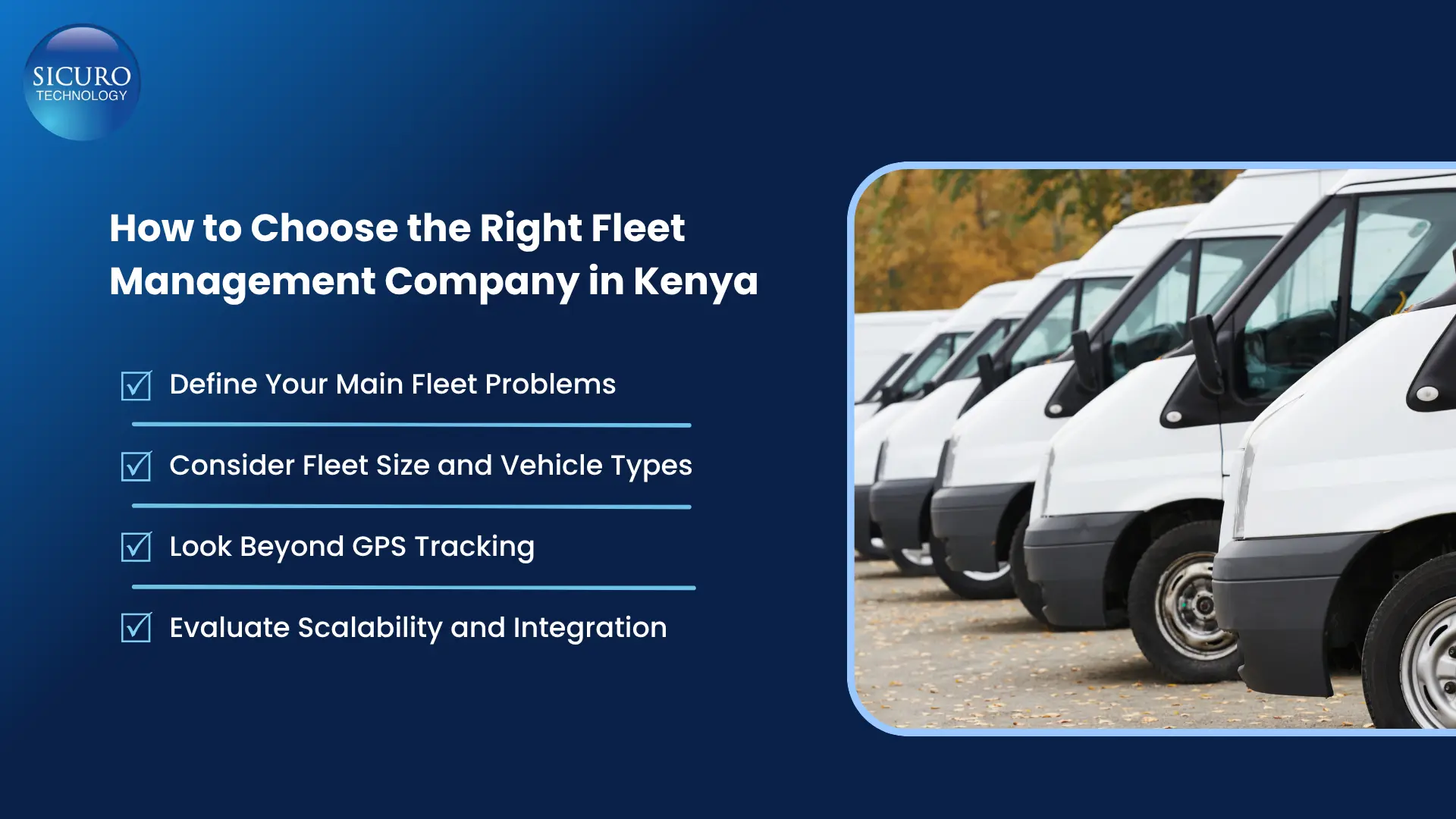
Choosing among fleet management companies in Kenya should start with your operational requirements rather than the provider’s marketing claims.
Before selecting a partner, consider:
Define Your Main Fleet Problems
Are you primarily trying to reduce:
- Fuel costs?
- Fuel theft?
- Accidents?
- Vehicle downtime?
- Unauthorized vehicle use?
- Delivery delays?
- Maintenance costs?
The answer will determine which capabilities should be prioritized.
Consider Fleet Size and Vehicle Types
A small delivery fleet may have different requirements from a large logistics operation, construction fleet, or government vehicle pool.
Consider whether the solution supports your:
- Cars
- Vans
- Trucks
- Buses
- Heavy machinery
- Trailers
- Specialized assets
Look Beyond GPS Tracking
Basic GPS tracking can tell you where a vehicle is.
A comprehensive fleet management platform should help explain what the vehicle is doing, why it is doing it, and how that activity affects your costs and safety.
This is where fuel analytics, driver behavior monitoring, video telematics, diagnostics, maintenance, and fleet intelligence become important.
Evaluate Scalability and Integration
Your fleet management platform should be able to grow with your business.
Consider whether the system can integrate with existing operational processes and support additional vehicles, assets, sensors, cameras, and data sources as your operation expands.
Selecting the Right Solution for Your Fleet
Kenya’s fleet management market includes very different types of providers. Some focus on telematics and real-time tracking, others on vehicle leasing and maintenance, while organizations emphasize driver training and operational safety.
The right choice depends on what your business actually needs.
Assessing Your Operations: Leasing vs. Telematics Technology
If your main challenge is vehicle acquisition, financing, or maintenance, a leasing and mobility provider may be the appropriate partner.
If your vehicles are already in operation and the challenge is reducing fuel costs, improving safety, preventing theft, optimizing routes, and increasing fleet efficiency, a technology-focused fleet management provider may offer more value.
For businesses looking to move beyond basic GPS tracking, Sicuro Technology combines real-time GPS fleet tracking, fuel monitoring, driver behavior analytics, video telematics, IVMS, maintenance intelligence, and fleet analytics into a more comprehensive approach to fleet management.
Ultimately, the best fleet management solution is not the one with the most features. It is the one that gives fleet managers actionable visibility into their biggest operational problems—and turns that visibility into measurable improvements in cost, safety, utilization, and fleet performance.
